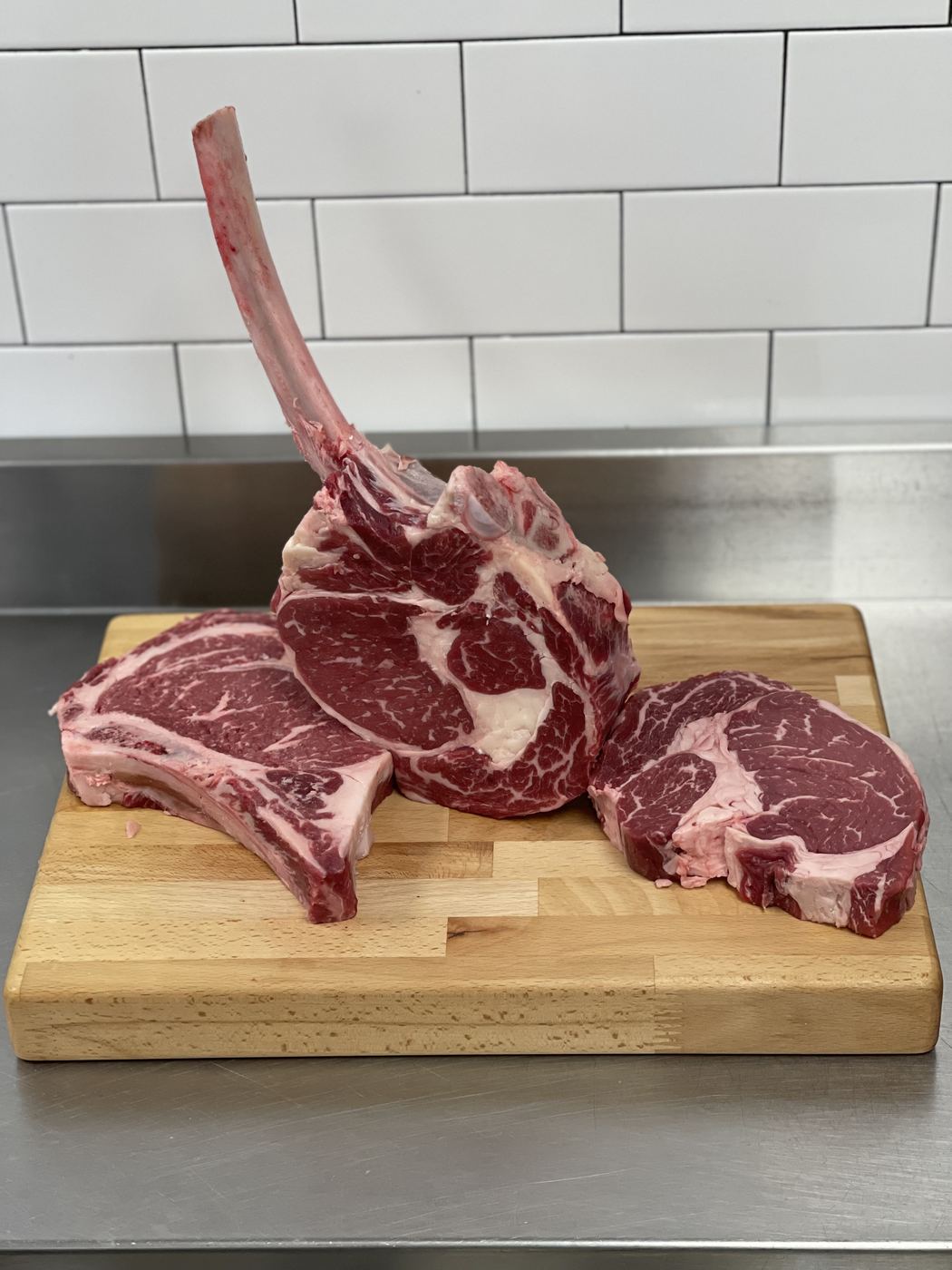

Choose boneless ribeye for straightforward slicing and serving. Choose bone-in ribeye when you enjoy carving around the bone and want a standout presentation. Neither is automatically the better steak—or the better deal.
The useful comparison comes down to thickness, meat quality, usable portions and the price of the actual cuts in front of you. Here’s how to choose between bone-in and boneless ribeye without paying for features you don’t need.
Bone-In vs Boneless Ribeye: The Quick Answer
- For individual portions: boneless ribeye is convenient to slice and serve.
- For a centrepiece: a bone-in ribeye or long-bone tomahawk adds presentation.
- For value: compare the total price and estimated usable meat, not just the price per pound.
- For cooking: consider thickness and shape rather than assuming every boneless steak cooks quickly.
- For flavour: don’t choose on bone alone. Compare marbling, grade, ageing and preparation too.
Shopping locally? Explore Pat’s Boneless Ribeye and Tomahawk Steak, then call ahead to discuss the cut you want.
Does Bone-In Ribeye Taste Better?
Not automatically. The claim that a bone guarantees a more flavourful steak is too simple—but saying research proves there is never a difference goes too far as well.
A Kansas State University study compared bone-in and boneless beef cuts under controlled conditions. Consumer ratings for ribeye did not show statistically significant differences in tenderness, flavour, juiciness or overall liking attributable to bone state. However, trained panellists rated beef flavour intensity higher in bone-in ribeye.
The study used particular grades, ageing conditions and cooking methods. It does not prove that every bone-in and boneless steak will taste identical.
The buying takeaway: a bone is not a flavour guarantee. Look at the whole steak and choose the qualities you enjoy, rather than treating bone-in as an automatic upgrade.
Which Ribeye Is Better Value?
Boneless ribeye removes bone weight from the purchase, but that does not make it cheaper in every comparison. Different prices, trimming and meat quality can change the result.
Before deciding, ask:
- What is the total price? Compare the actual steaks, not only their advertised unit prices.
- How much usable meat is there? Bone and any fat you choose not to eat affect portions.
- Are the cuts comparable? Different grades, ageing or thickness can make a price comparison misleading.
- Does presentation matter to you? A long-bone steak may be worth choosing for the occasion, even if it is not the lowest-cost option.
For example, two steaks with the same total weight will not necessarily provide the same amount of meat if one includes a substantial bone. Equally, sharing a large bone-in steak does not make that bone weight disappear from the cost.
Ask at the counter: “For this many people and this budget, which of these cuts gives me the portions I need?”
Does Bone-In Ribeye Take Longer to Cook?
Bone can affect how a steak cooks, but there is no reliable rule that you should add a fixed number of minutes. Thickness, starting temperature, cooking equipment and heat level also matter.
A thick boneless ribeye can need more cooking time than a thinner bone-in steak. Likewise, a large tomahawk should not be cooked using timings written for a small skillet steak.
- Compare thickness first: total weight alone does not tell you how quickly the centre will cook.
- Check equipment fit: a long rib bone can make a tomahawk awkward in a smaller pan.
- Use a thermometer: colour and minutes per side are not dependable substitutes for an internal reading.
- Check each steak: pieces cooked together may still finish at different times.
How Should You Cook Each Cut?
Boneless Ribeye
Boneless ribeye is convenient for pan cooking and slicing because there is no bone to work around. Choose a pan that holds the steak comfortably and use a method suited to its thickness.
For a thicker cut, you may need a gentler cooking stage as well as searing. Boneless does not automatically mean that a few minutes of high heat will cook the centre sufficiently.
Bone-In Ribeye or Tomahawk
Before starting, make sure the whole cut fits your grill, oven tray or pan. For a thick steak, a reverse-sear approach—gentle cooking followed by a hot sear—is one option to consider.
On a grill, having a lower-heat area available lets you move the steak away from intense heat while continuing to cook the centre. Avoid relying on a fixed “minutes per side” formula.
Check the Internal Temperature
Health Canada’s cooking guidance lists 63°C (145°F) for medium-rare whole beef cuts, 71°C (160°F) for medium and 77°C (170°F) for well done.
Insert a digital food thermometer into the centre of the thickest part of the meat without touching the bone. Check each piece separately and follow any additional preparation instructions supplied with the product.
Is a Tomahawk the Same as a Bone-In Ribeye?
A tomahawk is a bone-in ribeye with a long rib bone left attached and trimmed for presentation. Pat’s Tomahawk Steak is listed as a French-trimmed long-rib cut.
That distinctive shape makes it a centrepiece option, but it does not establish how many people one steak will feed. Ask about the actual weight, thickness and expected portions before ordering.
- Choose it for: a shared meal where carving and presentation are part of the experience.
- Check first: cooking space, portion requirements and total price.
- Don’t assume: every tomahawk is the same size or feeds a fixed number of guests.
What Should You Ask Your Butcher?
A short conversation can be more useful than choosing by appearance alone. Tell the team:
- How many people you are feeding.
- Whether you want individual steaks or one cut to share.
- Your preferred thickness.
- Whether you will use a skillet, oven or grill.
- Your budget.
- When you plan to collect and cook the order.
Ask about current availability, pricing and any specific grade or ageing preference. Do not assume every option is available for every cut on the day.
Choose Your Ribeye in Georgetown
Pat’s Prime Cuts lists both boneless ribeye and tomahawk steak, with custom thickness and trimming requests available to discuss with the shop.
- Explore Boneless Ribeye for a cut that is straightforward to portion and slice.
- Explore Tomahawk Steak for a long-bone presentation cut.
Not sure which to order? Call (905) 873-0352 with your guest count and cooking method. Confirm your preferred cut, current price and pickup arrangements before heading to the Georgetown shop.
Frequently Asked Questions
Is boneless ribeye always cheaper?
No. It excludes bone weight, but the actual value depends on the price, quality, trimming and usable portions of the steaks being compared.
Which ribeye is easier to slice?
Boneless ribeye is more straightforward because you do not need to remove or carve around a bone. That makes it convenient for individual servings or sliced steak platters.
Can I reverse sear a boneless ribeye?
Yes. Reverse searing is not limited to bone-in steaks. Whether it suits your steak depends particularly on thickness and the cooking equipment you are using.
How many people does one tomahawk feed?
There is no fixed answer. Steak size, bone weight, appetites and accompanying dishes all matter. Discuss your portions with the butcher before ordering.
Should I choose bone-in or boneless for a special dinner?
Choose bone-in if you enjoy the presentation and carving experience. Choose boneless if you prefer simple slicing and serving. Either can suit a special meal; the bone alone does not determine quality.


