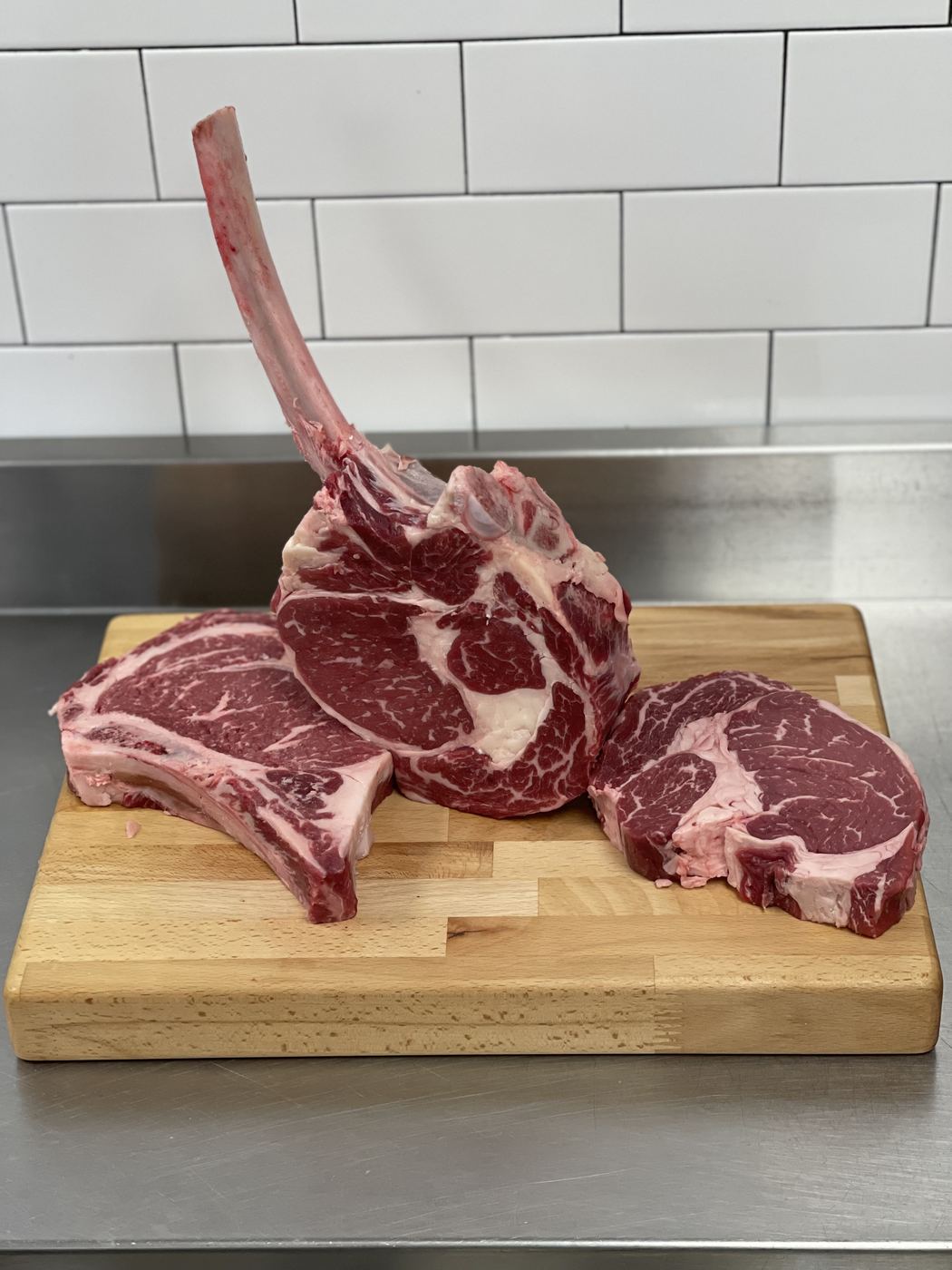

Canada’s top beef grades, ranked by marbling, are Canada Prime, Canada AAA, Canada AA and Canada A. Marbling, the flecks of fat woven through the muscle, is what separates them and drives flavor and juiciness. Grading itself is voluntary; only CFIA inspection for safety is mandatory. The practical rule: reach for Prime or AAA when you’re grilling or roasting fast, and save AA or A for braises, stews, and stretching your grocery budget.
TL;DR:
- Prime beef is very rare, making up less than 5% of graded cattle, and commands a premium because of its high marbling and tenderness.
- The grading process assesses marbling, maturity, muscling, and color, with camera-assisted tools supported by a trained grader to ensure accuracy.
- Yield grades indicate how much sellable meat a carcass provides, with lower yields increasing trimming waste and affecting cost-efficiency regardless of quality grade.
- Choosing beef by grade should depend on the cooking method: Prime and AAA excel in fast, high-heat cooking, while AA and A work better for slow, moist methods like braising.
- Domestic and export beef grades align somewhat with USDA grades, but always verify official inspection legends and origin labels for accurate quality information.
Table of Contents
- What Do Canadian Beef Grades Actually Mean?
- How Is Canadian Beef Actually Graded?
- What Do Canada’s Yield Grades Mean for Your Plate?
- Which Grade Should You Buy for Grilling, Braising, or Ground Beef?
- How Do Canadian Beef Grades Compare to USDA Grades?
- How Pat’s Prime Cuts Applies These Grades Every Day
- Live Animal Grading vs. Carcass Grading: What’s the Difference?
- Where Did Canada’s Beef Grading System Come From?
- How Do Grades Affect What You Pay for Beef?
- Why Does Grading Matter for Export and Trade?
- Where to Verify Official Canadian Beef Grade Standards
- Our Take: Grades Are a Starting Point, Not a Verdict
- Ready to Put These Grades to Work in Your Kitchen?
- Sources
What Do Canadian Beef Grades Actually Mean?
A grade stamp on a carcass is shorthand for how much fat is marbled through the muscle, plus a handful of other traits graders check by eye and by camera. For adult cattle, Canada recognizes four quality grades built primarily on marbling: Canada Prime, Canada AAA, Canada AA and Canada A. Each one corresponds to a marbling category, and the categories move in a clear line from “barely there” to “abundant.”
- Canada Prime: slightly abundant marbling or higher. The richest, most consistently tender grade, and the rarest on shelves.
- Canada AAA: small to moderate marbling. This is the grade most Ontario butcher counters build their steak case around.
- Canada AA: slight marbling. Leaner than AAA but still suited to a hot pan if you don’t overcook it.
- Canada A: trace marbling. Lean, economical, and better suited to methods that add moisture back in.
Below those four sit the B grades (B1 through B4), which cover carcasses with acceptable but less desirable traits, like yellowish fat or coarser muscling, and the D and E classes, largely from older or breeding animals. Meat from these lower classes rarely reaches the retail case as whole cuts. It gets routed into ground beef, sausage, and processed products instead, which is one reason a package of ground chuck costs less than a striploin even though both started as beef.
Canada Prime is genuinely scarce. It made up just 4.8% of graded fed slaughter cattle in 2023, while AAA, AA and A together account for the bulk of what actually moves through Canadian grocery stores and butcher shops. That scarcity is exactly why Prime commands a premium and why a lot of home cooks never taste it outside a steakhouse.
Grading doesn’t stop at marbling, either. Graders also weigh maturity (how mature the animal was at slaughter), meat and fat colour, and overall muscling. A carcass with beautiful marbling but dark, mature-looking meat or poor muscling can still get bumped out of the top classes, regardless of how much fat is threaded through the ribeye.
How Is Canadian Beef Actually Graded?
Grading only happens after a carcass clears inspection, never before. A carcass must carry a CFIA inspection legend before a grader can touch it, which is the legal line between “safe to sell” and “graded for quality.” The two systems run separately: CFIA protects public health, and the Canadian Beef Grading Agency (CBGA) certifies and audits the graders who assess quality.
Here’s roughly how it plays out on the plant floor:
- CFIA inspection and stamping. The carcass is checked for food safety and cleared with an inspection legend.
- Chilling. Carcasses hang and cool, which stabilizes the fat and lets marbling show up clearly.
- The ribeye cut. Graders expose the muscle between the 12th and 13th ribs, the standard window for judging marbling amount, size, and spread.
- Maturity check. Graders look at bone and cartilage ossification, essentially a read on how physiologically mature the animal was.
- Camera-assisted scoring. Many plants now run instrument-augmented grading, where a camera scans the exposed ribeye and estimates marbling score and retail yield in seconds.
- Certified grader sign-off. A CBGA-certified grader reviews the result and can override the camera’s read if something doesn’t match what they see in the muscle or fat.
That last step matters more than most shoppers realize. The camera is fast and consistent, but it’s a tool, not the final word. A trained grader still has the authority to catch what a lens misses, which keeps the system honest across thousands of carcasses a day.
Pro Tip: If you’re buying whole or half carcasses for a freezer order, ask whether the grading was camera-assisted or fully manual. It won’t change the grade stamp, but it’s a good conversation starter with a supplier who actually knows their product.
What Do Canada’s Yield Grades Mean for Your Plate?
Quality grade tells you about eating experience. Yield grade tells you how much usable meat you actually get off that carcass, which is a different question entirely. The yield formula factors in external fat depth, ribeye area, hot carcass weight, and kidney/pelvic/heart (KPH) fat to estimate the percentage of closely trimmed, boneless retail cuts a carcass will produce.
- Canada 1: roughly 52.3% to 52.4% or more retail yield. Lean carcass, high cutout.
- Canada 2 to 4: a sliding scale in between, with yield dropping as external fat and waste increase.
- Canada 5: below about 45.0% retail yield, meaning nearly half the carcass weight is fat, bone, and trim loss rather than sellable meat.
A carcass can be Canada Prime for quality and still land in the middle of the yield scale if it’s carrying more external fat. That combination matters to a butcher’s math: a lower yield grade means more trimming, more waste, and a higher effective cost per pound of usable meat, even when the quality grade on the label reads impressively. It’s part of why the same “AAA” stamp can show up at very different price points depending on the carcass behind it.
Which Grade Should You Buy for Grilling, Braising, or Ground Beef?
Match the grade to the cooking method, not the other way around. High marbling grades reward fast, high-heat cooking because the fat renders and self-bastes the muscle in minutes. Leaner grades need time and moisture to break down connective tissue and stay tender, which is exactly what a braise or a slow stew provides.
- Canada Prime or AAA: grilling, pan-searing, roasting hot and fast. Think striploin steak or a tenderloin roast for a dinner party.
- Canada AA or A: braises, stews, pot roasts, and anywhere you’re cooking low and slow with liquid. A boneless chuck roast is the classic example.
- Ground beef and sausage: marbling matters far less here because fat is already blended in during grinding, so cheaper grades work fine without sacrificing flavor.
- In between: a boneless blade steak can go either way depending on how it’s trimmed and cooked.
At the counter, look for the grade stamp itself, the CFIA inspection legend, and any province-of-origin claim on the package. Ontario-raised beef versus Alberta-raised beef doesn’t change the grade, but it does affect freshness in transit and, for a lot of Ontario shoppers, it matters on principle.
Pro Tip: When you’re booking beef for a wedding or a backyard event months out, ask your butcher about seasonality. Grass-finishing patterns and herd cycles mean marbling can run slightly leaner in late winter than in fall, which is worth knowing if you’re planning a steak-heavy menu.
How Do Canadian Beef Grades Compare to USDA Grades?
Canadian and American grades line up closely but not perfectly, since the two systems weigh marbling and maturity a little differently. As a rough guide: Canada Prime tracks with USDA Prime, Canada AAA lines up with USDA Choice, Canada AA sits near USDA Select, and Canada A resembles USDA Standard.
Treat that as an approximation, not a conversion table. When beef crosses the border in either direction, CFIA requires imported meat to meet Canadian grade equivalency before it can be sold or labeled here, and labeling rules dictate exactly how grade names can appear on packaging. The practical takeaway for shoppers: always check the inspection legend on the label and ask where the meat originated, since a US-grade sticker on Canadian shelves means something specific under CFIA rules, not just a marketing claim.
How Pat’s Prime Cuts Applies These Grades Every Day
Seventy-plus years in Georgetown has taught us that a grade stamp is a starting point, not the whole story. We source with quality grade in mind, then let occasion decide the cut. Family steak night calls for AAA, chosen for consistent marbling without Prime’s price tag. A big braise for a crowd or a budget-conscious cut works better in AA, where custom trimming and a little extra aging close the tenderness gap that lower marbling leaves behind.
That’s the value a counter butcher adds that a grade stamp alone can’t: matching the right grade to your actual meal, not just the highest number available. If you’re planning a menu around a specific grade or need allergy-safe recipes for an event, our catering services team builds the cut list around what you’re actually cooking.
Live Animal Grading vs. Carcass Grading: What’s the Difference?
Canada’s official quality and yield grades apply to carcasses after slaughter, not to live animals walking around a feedlot. That distinction trips people up constantly, especially in industry conversations where “grading” gets used loosely for both.
Live animal assessment happens earlier and serves a different purpose. Buyers, feedlot operators, and packers estimate finish, muscling, and expected yield by eye and by hand, essentially predicting what a carcass grade might come out to once the animal is slaughtered and chilled. It’s an informed guess based on visual and physical cues, useful for pricing decisions at auction or for deciding when an animal is ready for market.
Carcass grading is the official, measured version of that guess. It happens only after slaughter, after CFIA inspection, and after the carcass has chilled long enough for fat and muscle to settle into a stable, readable state. Graders expose the ribeye, check maturity indicators, and assign an actual grade based on measured marbling, not a prediction. The two processes are related in that live assessment tries to forecast carcass grade, but only carcass grading produces the number that ends up on a wholesale invoice or, eventually, a retail label.
For anyone buying whole or half carcasses directly from a producer, understanding this gap matters. A verbal estimate from a farm about “probably AAA” isn’t binding until the carcass is actually graded after slaughter.

Where Did Canada’s Beef Grading System Come From?
Canada’s formal beef grading system traces back to efforts earlier last century to standardize how carcasses were described and priced across a country where cattle moved long distances between farm, feedlot, and packing plant. Before standardized grades, buyers and sellers had no shared language for quality, which made pricing inconsistent and disputes common.
The system has evolved substantially since then, most notably in how yield grades are calculated. As of January 2019, Canada harmonized its retail yield formula more closely with the American approach, using external fat depth, ribeye area, hot carcass weight, and KPH fat to estimate the percentage of boneless closely trimmed retail cuts. That alignment made cross-border trade comparisons more consistent, even though the quality grade categories themselves stayed distinctly Canadian.
Oversight has also shifted over the decades toward the current model: CFIA handles food safety inspection, while CBGA certifies and audits the graders who apply quality and yield standards. That separation of duties, safety on one side, quality grading on the other, is itself a product of this history. It reflects lessons learned about keeping mandatory public health enforcement independent from a voluntary, industry-run quality system. The result is a grading structure that’s had decades to get refined, tested against real market disputes, and adjusted as cattle genetics and consumer preferences shifted.

How Do Grades Affect What You Pay for Beef?
Grade is one of the biggest levers on price at both the wholesale and retail level, mostly because Prime and AAA supply is genuinely limited. With Prime sitting at under 5% of graded fed cattle, packers and retailers know exactly how scarce that grade is, and pricing reflects it. That scarcity premium shows up most visibly on steak cuts, where marbling is the entire point of the purchase, and shows up far less on cuts destined for slow cooking or grinding.
Yield grade adds a second, quieter pricing pressure. A carcass with a lower yield grade produces less usable retail meat per pound of hanging weight, which means more trim loss and more labor for a butcher to turn it into sellable cuts. That cost gets absorbed somewhere, and it’s usually reflected in the price per pound of the finished product, even when two carcasses carry the same quality grade stamp.
This is also why the same grade can price differently between a big-box grocery chain and an independent butcher shop. Volume buyers negotiate on wholesale carcass price and grade mix in bulk, while a smaller shop sourcing specific carcasses for quality has less room to average costs across thousands of pounds. Neither approach is dishonest. They’re just different economics built on the same grading system, which is part of why comparing a steak’s price tag across two stores without knowing the actual grade behind it tells you very little.
Why Does Grading Matter for Export and Trade?
Canadian beef grading isn’t just a domestic quality signal. It functions as the common language that lets Canadian beef move into export markets with a verifiable standard attached. When a shipment of Canadian beef arrives at a port in another country, the grade stamp and the CFIA inspection legend together tell that country’s regulators and buyers exactly what they’re receiving, without needing to inspect every cut individually.
That matters enormously for trust in international trade. Countries importing Canadian beef rely on Canada’s grading and inspection systems being consistent and independently audited, which is precisely why CBGA certification and CFIA oversight exist as separate, accountable bodies rather than self-reported claims from individual producers. A grade that means something reliable at home is what allows it to mean something reliable abroad.
The equivalency question runs both ways as well. Just as CFIA requires imported meat to meet Canadian grade standards before it can be labeled and sold domestically, Canadian exporters need their grading claims recognized as equivalent by the destination country’s regulators. That mutual recognition between grading systems, Canada and the US in particular, is part of what keeps cross-border beef trade running smoothly instead of requiring costly re-inspection at every crossing.
Where to Verify Official Canadian Beef Grade Standards
For anyone who wants the primary sources rather than a summary, the CBGA’s grade requirements document lists all 13 official grades with measurement standards. BeefResearch.ca covers carcass grading and yield formulas in plain language, Canada Beef explains grading from a consumer angle, and CFIA’s labelling guidance governs what can legally appear on a package.
Our Take: Grades Are a Starting Point, Not a Verdict
The conventional advice, “buy the highest grade you can afford”, isn’t wrong, but it’s incomplete. It treats grade as a hierarchy when it’s really a description of marbling for one specific outcome: how a cut performs under fast, dry heat. Buy Canada A for a pot roast and you haven’t bought a lesser product. You’ve bought the right product, because that grade’s leanness is precisely what a long braise is designed to fix.
Where most guidance falls short is yield. Shoppers fixate on the quality letters and ignore that a carcass’s yield grade can quietly inflate the real cost per usable pound, regardless of how impressive the marbling looks. A butcher who understands both numbers, and adjusts trimming and pricing accordingly, delivers more actual value than one who just chases Prime and AAA volume.
If there’s one thing to prioritize, it’s asking questions at the counter instead of reading the stamp in isolation. Grade tells you what the meat is. A good butcher tells you what to do with it.
— cloudsprout
Ready to Put These Grades to Work in Your Kitchen?
Reading a grade stamp only gets you halfway. What actually determines whether that AAA striploin turns out right is the cut, the trim, and whether someone who knows the carcass helped you choose it, which is exactly where a counter butcher earns their keep over a shrink-wrapped tray at a chain grocery store. At Pat’s Prime Cuts, we hand-select and hand-cut every order in Georgetown, so the grade on the label matches the cut that actually fits your meal, whether that’s a Boneless Ribeye for Saturday’s grill or a value-focused braise for a weeknight crowd.

We also build custom orders around allergy-safe recipes, house marinades, and event-specific cuts, something no pre-packaged grade stamp can do for you. If you’re planning a dinner, a backyard party, or a full event, browse our catering services or stop by the shop to talk through which grade actually fits your menu. Ask us directly, and we’ll match the cut to the cooking method before you leave the counter.
Sources
- Beefresearch
- Graded for Greatness – Canadian Beef | Canada Beef
- Grade requirements for imported meat products — CFIA


