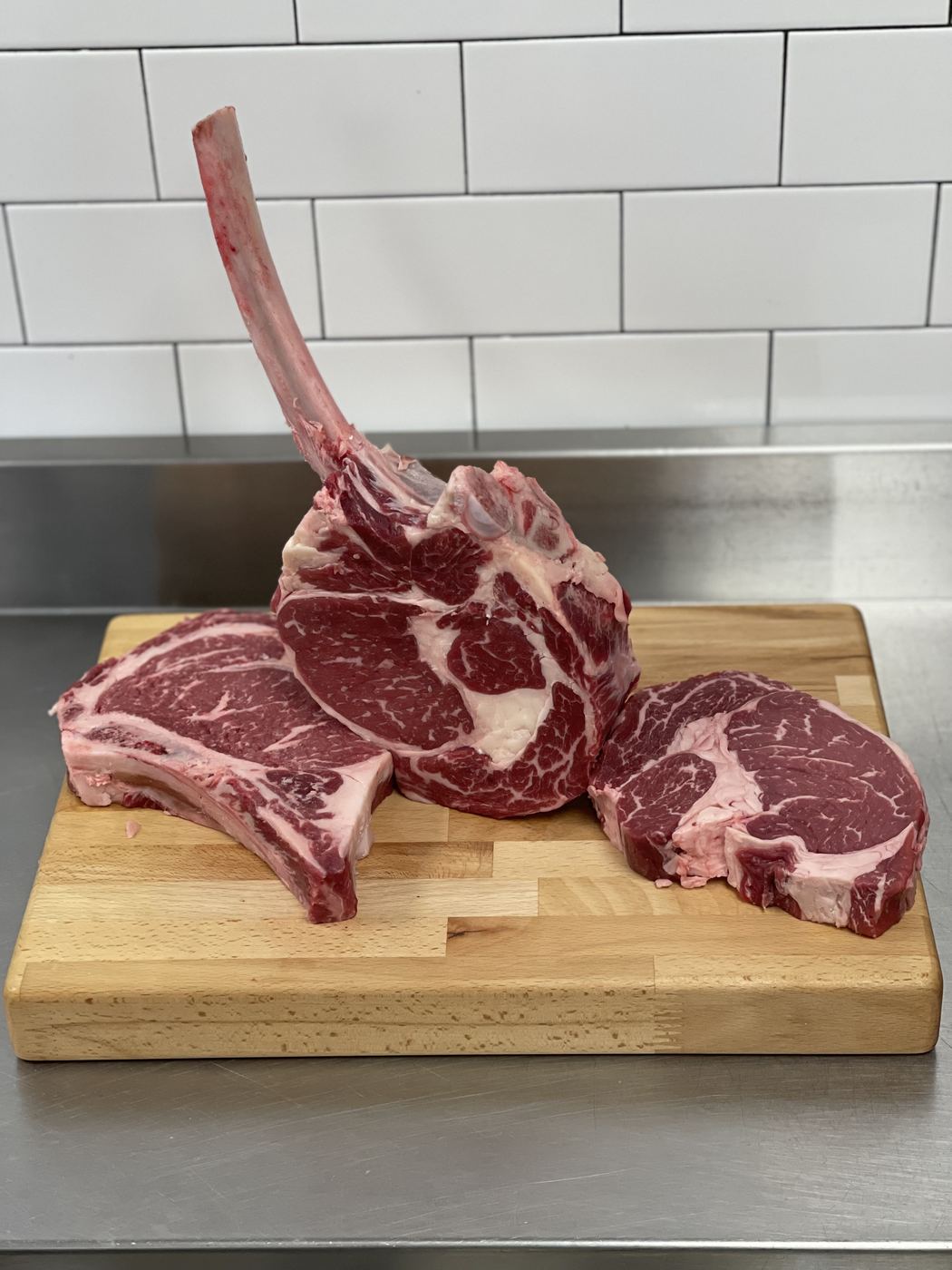

Choose ribeye when you want maximum richness and a steak that forgives a slightly late flip. Choose strip when you want a cleaner, beefier bite and an easier road to a perfect pan sauce. The difference comes down to marbling: ribeye carries fat through the muscle, strip carries it mostly on the edge. Pick by flavor preference first, cooking method second, and how much margin for error you want third.
TL;DR:
- Ribeye’s internal marbling provides extra forgiveness against overcooking, making it more suitable for late flips and less experienced cooks.
- Strip steak’s uniform muscle texture and lower fat cap make it ideal for pan sauces and achieving a consistent, beefy flavor.
- Choosing between them depends on flavor preference first, with ribeye offering richness and strip providing a cleaner taste with easier cookery control.
- Thickness of 1.5 to 2 inches is recommended for both cuts, with thicker steaks better at building crust without overcooking inside.
- Prices for ribeye usually exceed those of strip, especially at higher grades, but well-marbled strip can outperform premium ribeye in flavor and value.
Table of Contents
- Ribeye vs Strip Steak: Where Each Cut Comes From
- Flavor, Texture, and Mouthfeel: The Real Ribeye vs Strip Steak Test
- How to Cook Ribeye and Strip Steak for the Best Result
- Buying Smart: Price, Grade, and What to Ask Your Butcher
- Ribeye or Strip Steak: Matching the Cut to the Occasion
- How a Local Butcher Thinks About Ribeye vs New York Strip
- Calories, Fat, and Protein: Ribeye vs Strip Steak Side by Side
- How Much Steak to Buy: Portion Sizes That Actually Work
- Kansas City Strip, New York Strip, and Other Naming Confusion
- A Butcher’s Honest Take on Ribeye vs Strip Steak
- Where to Get Hand-Cut Ribeye and Strip Steak
- Sources
- FAQ
Ribeye vs Strip Steak: Where Each Cut Comes From
The anatomy explains almost everything else about these two steaks. Ribeye is cut from the rib primal, specifically ribs six through twelve, and it includes the eye of the muscle along with the spinalis, better known as the ribeye cap. That cap is heavily marbled and often considered the best bite on the whole steak. Strip steak, sometimes labeled New York strip or top loin, comes from the short loin just behind the ribs. It’s built almost entirely from the longissimus muscle, a long, tighter-grained muscle that does less work than the rib area and carries most of its fat as a cap along one edge rather than threaded through the meat.
That structural split shows up in how each steak eats:
- Ribeye’s spinalis cap is looser grained, extra fatty, and noticeably more tender than the eye it wraps around, which is why a single ribeye can taste different bite to bite.
- Strip’s longissimus muscle is more uniform from edge to edge, so you get a consistent chew across the whole steak.
- Industry portion cut references classify ribeye as boneless ribeye, rib steak, or Delmonico, and strip as top loin, club steak, or hotel steak, depending on trim and bone.
- The rib primal that yields ribeye also produces prime rib roast, which is worth knowing if you’re deciding between a whole roast and individual steaks for a crowd.
Flavor, Texture, and Mouthfeel: The Real Ribeye vs Strip Steak Test
Marbling is the whole story here. Ribeye’s intramuscular fat melts as it cooks, basting the meat from the inside and producing a richer, almost buttery flavor that coats the tongue. The cap intensifies that effect, delivering a piece of steak some cooks argue is the best cut on the animal, full stop. Strip steak skips that internal basting. What you get instead is a firmer, more even chew and a flavor most people describe as cleaner and more distinctly “beefy,” without the fat softening every bite.
Marbling does more than add flavor. It acts like insurance against overcooking, since the fat keeps the muscle fibers from drying out even if you miss your target temperature by a few degrees. Strip doesn’t have that cushion. A ribeye pulled a little late is still juicy; a strip pulled a little late tends toward dry.
A few practical differences worth knowing before you shop or cook:
- Ribeye’s marbling is visible as thin white streaks throughout the meat, not just around the edge.
- Strip’s fat sits mostly as a cap you can trim or leave on for basting during the cook.
- Overcooked ribeye stays palatable longer than overcooked strip, thanks to that internal fat.
Fat as forgiveness: the same marbling that makes ribeye rich also buys you a wider window before the steak turns tough, which is the single biggest reason home cooks default to ribeye on nights when timing might slip.
Chef opinion backs this up directly. Grilling guidance from Simply Recipes notes that ribeye delivers the most richness and stands up better to minor timing mistakes, while strip is easier to cook evenly and holds up better when you need a flat, consistent surface for a pan sauce. Gordon Ramsay, for his part, praises ribeye’s marbling even though filet mignon is his personal favorite for pure tenderness, and he uses the same sear-and-baste technique across most cuts he cooks.
How to Cook Ribeye and Strip Steak for the Best Result
Thickness matters more than most home cooks realize. A steak cut between 1.5 and 2 inches thick gives you enough mass to build a deep crust on the outside without overshooting the interior temperature, a rule professional kitchens rely on for both cuts.
- Pick your thickness first. Ask for at least 1.5 inches on either cut; thinner steaks overcook before they brown properly.
- Grill ribeye with a plan for flare-ups. The fat that makes ribeye rich also drips and ignites, so keep a cooler zone on the grill to move the steak if flames get aggressive, and flip more often than you think you need to.
- Pan-sear strip when you want a sauce. Its cleaner surface and lower fat runoff leave a better fond in the pan, which makes deglazing with wine or stock far more rewarding than trying the same move after cooking a fatty ribeye.
- Reverse sear for thick cuts. Start in a low oven, finish with a hard sear in a screaming hot cast iron pan or on the grill. The New York Times Cooking method for rib-eye calls for patting the steak dry, seasoning simply, and basting with butter and garlic near the end for a deep crust.
- Use a thermometer, not a clock. Pull the steak about 5°F below your target since it keeps cooking off the heat. A reliable instant read thermometer, something like the Testo 106, removes the guesswork entirely.
- Rest before you cut. Five to ten minutes lets the juices redistribute instead of pooling on the cutting board, and always slice against the grain.
Pro Tip: If your ribeye keeps causing flare-ups on the grill, trim a little of the outer fat cap before cooking. You lose almost nothing in flavor since most of the richness comes from marbling inside the muscle, not the exterior fat.
Buying Smart: Price, Grade, and What to Ask Your Butcher
Ribeye usually costs more than strip at the same grade, and that gap widens fast once you move up to Prime. But grade and cut aren’t the whole value equation. A well-marbled Choice-grade strip can outperform a mediocre Prime ribeye on both flavor and price, especially since strip’s cleaner profile makes it a strong candidate for dry-aging, which concentrates flavor even further.
A few questions worth asking at the counter:
- How long has this been aged, and is it wet-aged or dry-aged?
- Can you cut this to 1.5 or 2 inches instead of the standard thickness?
- Do you have bone-in options, since bone-in ribeye and strip both hold flavor slightly differently than boneless?
- How much of the exterior fat cap would you trim if I asked?
Visual cues help too. Look for fine, evenly distributed white streaks in a ribeye rather than a few thick clumps, and check that a strip’s fat cap is bright white, not yellowish, which usually signals age or lower quality.
Ribeye or Strip Steak: Matching the Cut to the Occasion
- Special occasion, forgiving timing: Ribeye. It’s the steak that still tastes great if your guests show up late and dinner sits an extra five minutes.
- Pan sauce for a weeknight dinner: Strip. The cleaner fond and lower fat runoff make deglazing simple.
- Low cooking confidence or a distracted grill session: Ribeye. Marbling buys you room for error.
- Budget-conscious plating: Strip, more often than not, delivers better value per dollar without sacrificing much flavor.
- Leaner preference: Strip, straightforward and beefy without a heavy fat finish.
How a Local Butcher Thinks About Ribeye vs New York Strip
A butcher counter looks at these two cuts differently than a grocery case does. At Pat’s Prime Cuts, decades of hand-cutting steaks daily means the cut, thickness, and trim get matched to how you plan to cook, not just what fits a standard package.
- Want a forgiving grill night? Ask for a thicker boneless ribeye with light fat trimming to manage flare-ups.
- Building a pan sauce dinner? A striploin steak cut slightly thicker than standard holds up better under high heat.
- Curious about bone-in flavor? Ask about a rib steak instead of boneless.
Calories, Fat, and Protein: Ribeye vs Strip Steak Side by Side
Ribeye’s extra marbling shows up directly on a nutrition label. A cooked ribeye typically runs higher in total fat and calories than a strip steak of the same weight, mostly because of the intramuscular fat that makes it taste so rich. Strip steak trims closer to lean, with a fat cap you can remove entirely if you’re watching saturated fat intake, leaving a leaner cut with a similar protein count per serving.
Both cuts deliver a comparable amount of protein per ounce since protein content tracks with muscle mass, not fat. The real gap is in fat grams and, by extension, calories. If you’re grilling for a group where someone is tracking fat intake, a trimmed strip steak is the easier steak to serve without changing your menu, while ribeye remains the better choice when richness is the goal and calorie count isn’t a concern.
One detail worth knowing: the ribeye cap, the spinalis, carries even more fat than the rest of the eye muscle. If you’re portioning a ribeye for someone watching fat closely, that cap is the piece to trim first, not the rest of the steak. Strip’s fat cap is easier to manage for the same reason. It sits on one edge, so trimming it doesn’t touch the leaner meat underneath. Neither cut is a low-fat choice compared to something like sirloin, but between the two, strip is consistently the leaner option.

How Much Steak to Buy: Portion Sizes That Actually Work
A standard single-serving portion for either ribeye or strip runs between 8 and 12 ounces before cooking, enough for a satisfying dinner without excessive waste. For a lighter portion, especially when serving a strip steak alongside sides like a starch and a vegetable, 6 to 8 ounces works well since strip’s leaner profile feels substantial even in a smaller cut.

Ribeye, because of its higher fat content, can feel heavier at the same weight, so some hosts scale ribeye portions down slightly compared to strip when serving multiple courses. If you’re buying bone-in, add roughly 2 to 3 ounces to account for bone weight, since that portion isn’t edible meat.
For a dinner party, plan on one steak per guest rather than splitting larger cuts, since both ribeye and strip lose quality when reheated. If you’re cooking for a crowd and want to stretch a single cut further, a whole prime rib roast sliced into individual portions can serve more people from one purchase than buying pre-cut ribeye steaks, though it requires more oven time and planning.
Kansas City Strip, New York Strip, and Other Naming Confusion
The naming around strip steak causes more confusion than almost any other cut in the meat case. New York strip and Kansas City strip typically refer to the same muscle, the short loin’s longissimus, with the main difference being whether the bone is left in. Kansas City strip usually keeps a small piece of bone attached, while New York strip is most often sold boneless. Some butchers also label this cut top loin, club steak, or hotel steak depending on regional convention and how it’s trimmed.
Ribeye has its own naming quirks. Depending on where you shop, you might see it called rib steak, Delmonico, or spencer steak, and whether it’s bone-in or boneless changes which name applies. A “cowboy steak” typically refers to a thick-cut, bone-in ribeye with the rib bone frenched for presentation, which is a specialty cut worth requesting if you want a dramatic centerpiece for a dinner.
None of these naming differences change the underlying muscle or how you should cook it. What matters is confirming with whoever’s cutting your steak exactly which primal and muscle you’re getting, since a mislabeled cut can throw off your cooking plan entirely. When in doubt, ask directly whether a steak is from the rib primal or the short loin, since that answer settles the naming confusion faster than any label on the package.
A Butcher’s Honest Take on Ribeye vs Strip Steak
Most of the ribeye versus strip debate misses the actual decision point: it’s not about which cut is objectively better, it’s about which mistake you’re more willing to risk. Ribeye forgives a late flip. Strip punishes it. If you’re cooking for people who might linger over drinks before dinner, ribeye buys you insurance. If you want a clean pan sauce and total control over timing, strip rewards the effort. Neither cut is the wrong answer, just the wrong answer for a specific night.
— cloudsprout
Where to Get Hand-Cut Ribeye and Strip Steak
A local butcher shop has spent decades helping Georgetown and Halton Hills cooks pick the right steak for the night they’re planning, not just whatever’s sitting in a shrink-wrapped tray. That’s the real advantage of buying from a counter instead of a cooler case: you can ask for a boneless ribeye cut thicker for a forgiving grill night, or a striploin steak trimmed precisely for a pan sauce dinner, and get exactly that.

Custom thickness, bone-in versus boneless, and trim level are all requests Pat’s team handles at the counter, along with full-service catering if you’re feeding a crowd for a special occasion rather than a weeknight dinner. If you’re not sure which cut fits your plan, that’s exactly the kind of question the shop is built to answer in person. Stop by or call ahead to place a custom order for the cut, thickness, and trim that matches whatever you’re cooking next.
Sources
- Ribeye vs. New York Strip: Which Is Better for Grilling? A Chef Weighs In — Simply Recipes
- Rib-eye steak — New York Times Cooking
- Gordon Ramsay’s favorite steak cut — Tasting Table
- Stock Yards portion cut guide — US Foods
- Ribeye vs New York Strip — Sobremesa Press
FAQ
What Is Gordon Ramsay’s Favorite Cut of Steak?
Ramsay has said filet mignon is his personal favorite for tenderness, though he praises ribeye’s marbling and uses similar sear-and-baste techniques across most cuts he cooks.
What Cut Is Considered a “Poor Man’s Ribeye”?
Chuck eye steak, cut from the shoulder near the rib primal, is often called the poor man’s ribeye because it shares some of the same rich flavor and marbling at a lower price point, though it’s smaller and slightly less tender.
Which Is More Expensive, Ribeye or Strip Steak?
Ribeye typically costs more than strip at the same grade, and the price gap widens further at Prime grade. A well-marbled Choice strip can still deliver better value than a lower-quality Prime ribeye.
What’s the Best Cut of Steak Overall?
There’s no single best cut, only the best cut for what you’re cooking. Ribeye wins for richness and forgiveness on the grill, while strip wins for clean flavor and easier pan sauces, according to chef guidance on grilling both cuts.
Can Patsprimecuts Cut Ribeye or Strip to a Custom Thickness?
Yes, Patsprimecuts hand-cuts both boneless ribeye and striploin steak to order, including custom thickness and trim requests made in person or by phone.


