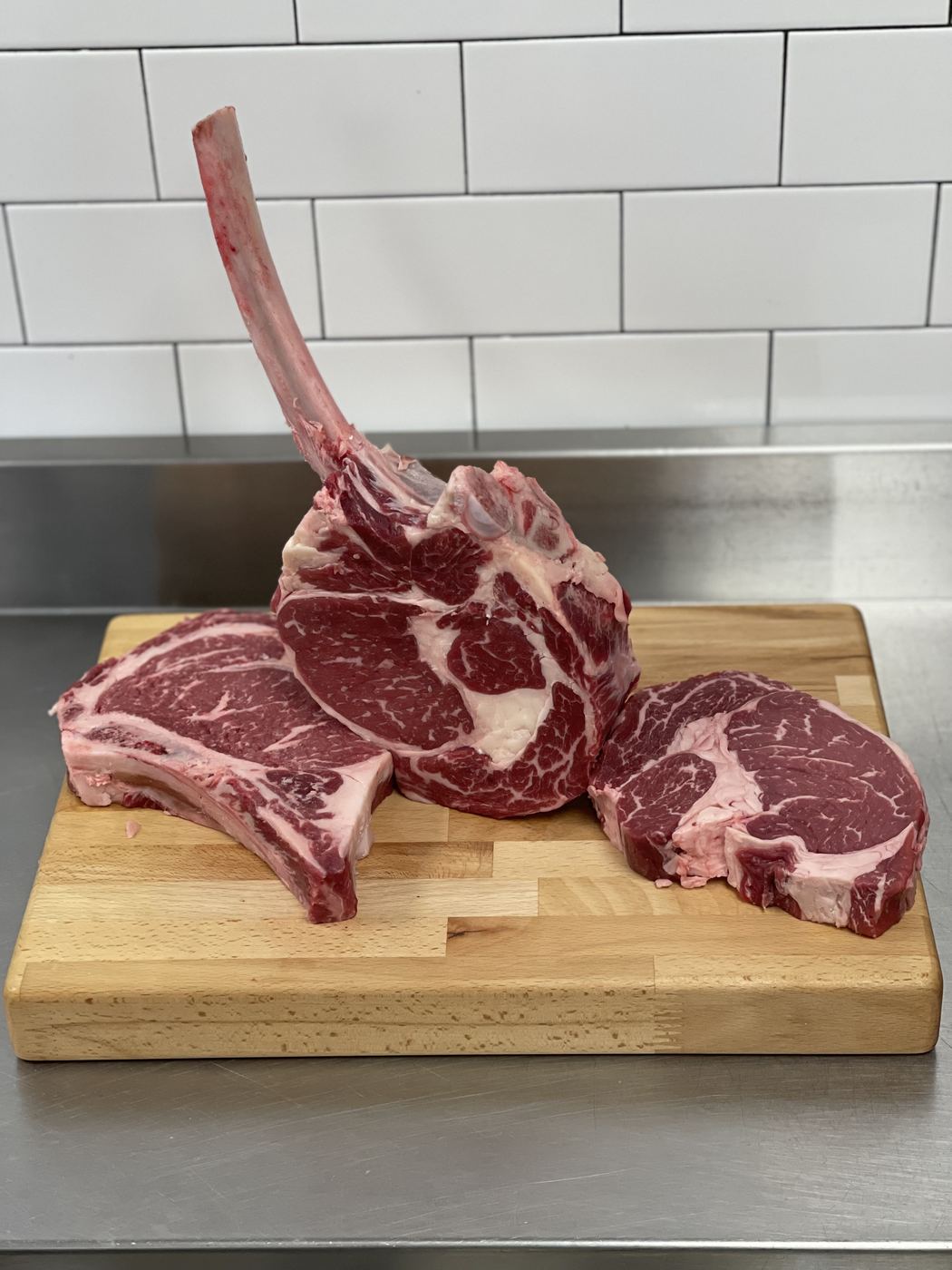

For many home grilling and pan-searing recipes, a steak around 1 to 1½ inches thick is a useful starting point. Thinner steaks cook quickly, while thicker steaks often benefit from a combination of searing and gentler heat. The best choice also depends on the cut, your equipment and how you plan to serve it.
This steak thickness guide explains how to choose a practical thickness, adjust your cooking method and check the result with a food thermometer. For shoppers in Georgetown, Ontario, it also includes questions to ask when ordering steaks from Pat’s Prime Cuts.
At a glance:
- Use thickness to help choose a method, not to predict an exact cooking time.
- Thin steaks need close attention because their centres heat quickly.
- Thick steaks can be seared and finished with gentler heat; reverse searing is another option, not a requirement.
- Use a thermometer to confirm internal temperature rather than relying on colour or minutes per side.
- Ask about the cut, available thicknesses and whether the beef has been mechanically tenderized.
Table of Contents
- Choosing a Steak Thickness
- How Thickness Changes Your Method
- Matching the Cut to the Method
- Internal Cooking Temperatures
- Why Timing Rules Are Limited
- Questions to Ask Your Butcher
- Cooking by Thickness
- Why Consistent Thickness Helps
- Explore Steaks in Georgetown
- Sources
What’s the Right Steak Thickness for Grilling and Searing?
There is no single ideal thickness for every steak. A thin cut can suit a quick meal, while a thicker cut offers more room to develop a browned surface using a staged cooking method.
The ranges below are practical starting points, not fixed rules or guaranteed cooking instructions. Follow a recipe suited to your particular cut and equipment, then check internal temperature.
| Approximate thickness | Possible approach | What to watch |
|---|---|---|
| ½–¾ inch (1.3–1.9 cm) | Direct grilling or pan-searing | The centre heats quickly; check early and avoid cooking solely by the clock. |
| 1–1¼ inches (2.5–3.2 cm) | Pan-searing or grilling, with gentler heat if needed | Adjust the heat if the surface browns before the centre reaches the target. |
| 1½–2 inches (3.8–5.1 cm) | Sear and finish over indirect heat or in an oven; alternatively, reverse sear | Allow time for the centre to cook without burning the outside. |
| Over 2 inches (over 5.1 cm) | A staged method suited to a very thick cut | Use a suitable recipe and check temperature in more than one location. |
A bone, an uneven shape, the starting temperature and the heat of your equipment can all affect cooking. Two steaks of the same thickness may still finish at different times.
How Thickness Changes the Method You Should Use
Heat needs to reach the centre without overcooking the surface. With a thin steak, this happens relatively quickly. With a thick steak, gentler heat can help finish the centre after the outside has browned.
- Direct cooking: Grill or pan-sear while monitoring both browning and internal temperature.
- Sear, then finish: Brown the surface, then move to indirect grill heat or an oven if the centre needs more cooking.
- Reverse sear: Begin with gentler heat, then sear towards the end. Check the final internal temperature after searing.
Reverse searing is not mandatory for a thick steak. A conventional sear followed by indirect heat can also work. If using sous-vide, follow a validated time-and-temperature recipe appropriate to the thickness and type of beef; a bath temperature alone is not a complete cooking instruction.
Matching Popular Cuts to the Right Method
Thickness is only part of the decision. Different muscles have different tenderness and connective tissue, so the cut itself matters too.
- Rib steak and boneless ribeye: Options to discuss for grilling or pan-searing, including thicker portions for staged cooking.
- Striploin and top sirloin: Ask which thickness suits your recipe, serving size and equipment.
- Beef tenderloin: Thick portions can suit a sear-and-finish approach, but tenderness does not prevent overcooking.
- Flank steak: Its shape differs from a thick ribeye. Use a cut-specific recipe and slice across the grain when serving.
- Blade and other working-muscle cuts: Confirm the precise cut and recommended method. Some benefit from moist cooking rather than a quick steak-style sear.
Do not assume that adding thickness or using a marinade will make every cut behave like a tenderloin. Canada Beef’s cooking-method guide explains why the method should match the cut.
What Internal Temperature Should You Cook Steak To?
For this Canadian guide, the temperatures below follow Health Canada’s cooking-temperature chart for beef steaks and other whole cuts:
- Medium-rare: 63°C (145°F)
- Medium: 71°C (160°F)
- Well done: 77°C (170°F)
Restaurant and recipe descriptions of doneness can use different temperatures. Lower culinary targets should not be presented as equivalent to these public-health recommendations.
Measure at the centre of the thickest part, avoiding bone, and check each steak separately. For thin steaks, position the probe so its sensing area reaches the centre. Clean the thermometer before use.
Mechanically tenderized beef: Follow its label instructions. Health Canada specifies 63°C (145°F) and turning mechanically tenderized steaks over at least twice during cooking. Ground beef has a different target: 71°C (160°F).
Do not assume resting will produce a fixed temperature increase. Confirm the applicable target has been reached; resting is not a substitute for adequate cooking.
Why the 3-3-3 Rule Is Not a Reliable Cooking Test
A rule such as three minutes per side followed by three minutes of rest cannot account for every steak and cooking setup.
- A thick steak heats differently from a thin one.
- A bone or uneven shape can affect where you need to check temperature.
- Pan material, grill heat and the number of steaks cooking together affect the result.
- Starting temperature and surface moisture can change cooking and browning.
Use recipe timings to organise your cooking, not to prove that the steak is ready. A thermometer provides the information a stopwatch cannot.
Questions to Ask Your Butcher
When shopping for steaks in Georgetown, explain your cooking plan before choosing by weight alone.
- Which cut suits grilling, pan-searing or a slower finish?
- What thicknesses are available?
- Can several portions be prepared to a similar thickness?
- Is the beef mechanically tenderized or injected?
- Are there specific preparation or cooking instructions?
- Does a custom order require advance notice?
A thicker steak may serve more than one person depending on its size and your menu. Confirm portions and price with the shop rather than assuming one steak always equals one serving.
Cooking Steak by Thickness Category
Keep beef refrigerated until preparation. If seasoning ahead, return it to the refrigerator rather than leaving it on the counter for hours. Use clean equipment and a recipe appropriate to the cut.
Thin Steaks: Approximately ½–1 Inch
- Prepare and season the steak according to your recipe.
- Preheat the pan or grill and pat the surface dry before cooking.
- Cook both sides, watching closely and checking internal temperature early.
- If the surface browns too quickly, reduce the heat while continuing to cook to the applicable target.
- Transfer to a clean plate and rest briefly before slicing.
Medium Steaks: Approximately 1–1½ Inches
- Preheat the cooking surface and prepare a gentler cooking area if needed.
- Sear for surface browning, then check the centre temperature.
- Continue over lower or indirect heat if the outside is browned but the centre needs more cooking.
- Confirm the applicable temperature before resting and serving.
Thick Steaks: Approximately 1½ Inches and Above
- Choose a recipe designed for a thick cut.
- Use a sear-and-finish or reverse-sear method to balance browning with cooking the centre.
- Monitor temperature throughout rather than adding a fixed number of minutes for each extra half inch.
- After the final cooking stage, check the centre and any other thick sections.
- Once the applicable target is reached, rest before slicing.
These steps describe an approach, not a tested recipe with guaranteed timings. Follow package instructions where provided, especially for mechanically tenderized beef.
Why Consistent Thickness Helps
Steaks of similar thickness are easier to organise on the grill because they have more comparable cooking requirements. This can help when preparing several portions for a family meal or gathering.
Consistency still does not guarantee identical cooking times. Check every piece rather than using the first steak as proof that the entire batch is ready.
Explore Steaks at Pat’s Prime Cuts in Georgetown
Browse the available boneless ribeye, striploin and beef tenderloin options, then contact Pat’s Prime Cuts to discuss your preferred thickness and cooking plan.

For a larger order, use the catering enquiry page to share your date, guest count and preferred cuts. Confirm availability, pricing, preparation and collection arrangements directly with the shop.


